

- All U.S. states offer disabled Veterans some form of property tax exemption, though eligibility is usually contingent on meeting certain disability ratings.
- Several states offer 100% disabled Veterans full property tax exemptions.
- States may require Veterans to renew their exemptions annually.
After a multi-year, nationwide effort to lessen the financial strain on qualified disabled Veterans, every state in the U.S. offers some sort of property tax exemption for disabled Veterans.
"If you're a disabled Veteran, in almost every single jurisdiction, you can petition your local taxing authority and you can have all of your local real estate taxes waived," said Mike Frueh, former National Director of the VA home loan program. "That's a fantastic benefit."
And that benefit could save you thousands on your property taxes.
Do Veterans Pay Property Taxes?
Veterans must pay property taxes unless exempt by their state’s property tax exemption laws.
Some Veterans, especially disabled Veterans, may be entitled to a property tax exemption for their primary residence. Eligibility and the exemption amount typically depend on VA disability rating, state, county and city.
For example, some states limit exemptions to Veterans with a 100% VA disability rating, while others go as low as 10%. Many states even reduce property taxes for all Veterans, regardless of medical condition.
According to the U.S. Bureau of Labor Statistics, 5.5 million Veterans have a service-connected disability, meaning millions of homeowners may be eligible for at least some level of property tax relief.
However, many homeowners don’t realize that property tax exemptions rarely apply automatically. In most cases, Veterans must apply through their county assessor, and approval often applies to a future tax year rather than the current one.
Full vs. Partial Property Tax Benefits
Property tax relief for service members and Veterans usually comes in one of three forms. A full exemption can eliminate property taxes entirely, a partial exemption lowers the tax bill and a tax credit reimburses some or all taxes paid.
If your state offers a partial exemption, make sure to work closely with your county assessor, as most partial exemptions do not go into effect until the following year. This may cause a shortage on your escrow, which will temporarily raise your payment above the regular amount with taxes until the shortage is paid back.
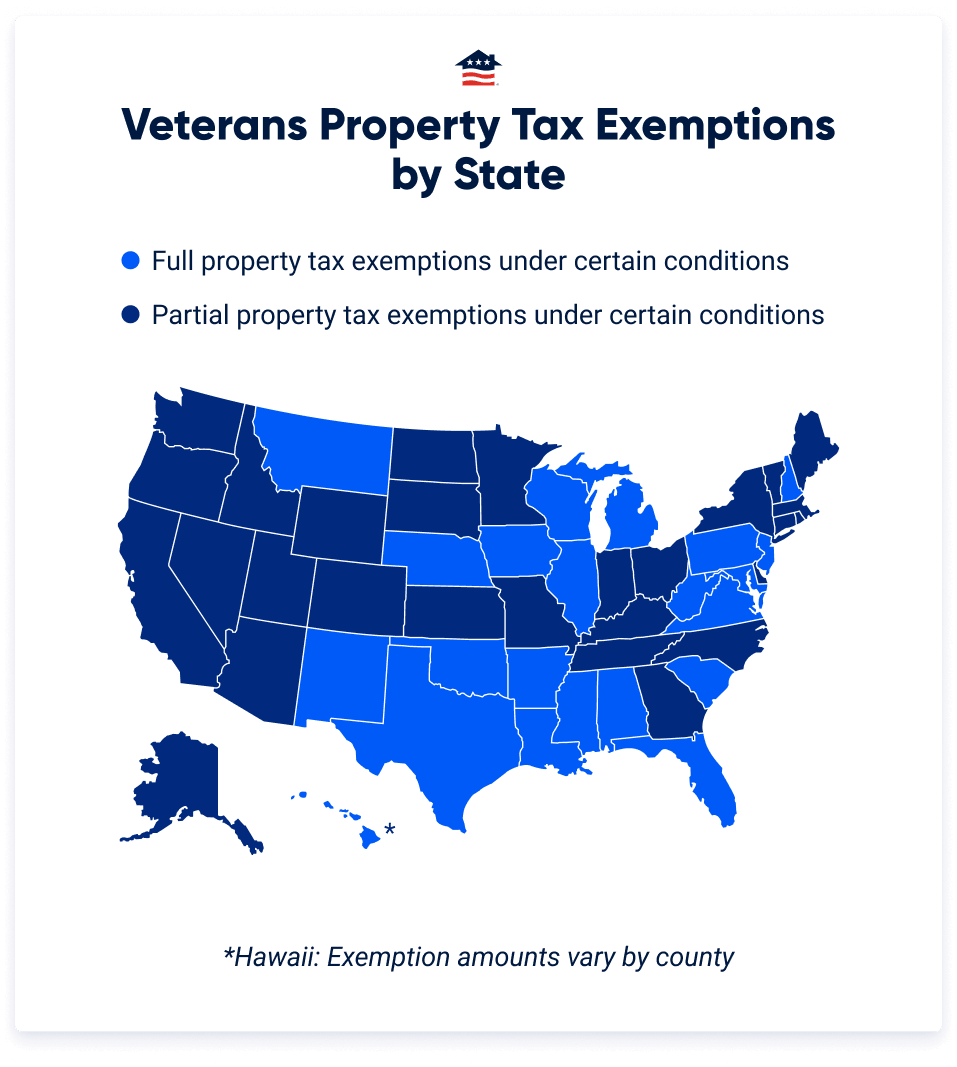
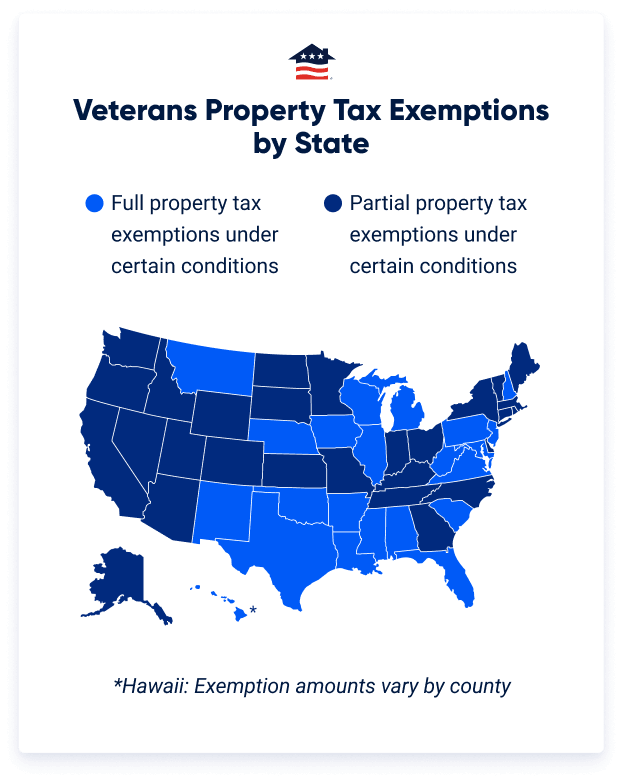
Property Tax Exemptions by State
Here is a short summary of each state's property tax exemptions available to qualifying Veterans. To ensure your eligibility, click the link next to the summary to see your state's complete tax exemption requirements.
Exemption amounts, rates and conditions can vary by county or city just as they do by state. Veterans should contact their local municipal tax assessor's office to check for localized exemptions.
| State | Minimum Disability Requirement |
|---|---|
| Alabama | Disabled Veterans in Alabama may receive a full property tax exemption if they have a 100% disability rating or are over the age of 65. The property cannot exceed 160 acres and must be a single-family home listed as the Veteran's primary residence. Non-ad valorem taxes are not exempt. |
| Alaska | Veterans with a disability rating of 50% or more may receive a property tax exemption up to the first $150,000 of the assessed value of their primary residence. The exemption may transfer to the spouse if the Veteran has passed and the spouse is at least 60 years old. |
| Arizona | In Arizona, Veterans with a 100% disability rating may qualify for a full property tax exemption. Veterans must be permanent Arizona residents. Income limits also apply: up to $39,865 for applicants without minor children and up to $47,826 for those with minor or disabled children. Veterans who do not have a 100% total and permanent disability rating are eligible for an exemption of up to $4,748 on their property's assessed value. |
| Arkansas | Disabled Veterans who have lost a limb or the use of a limb, are totally blind in one eye or both or have a 100% disability rating can receive a full property tax exemption in Arkansas. The exemption is valid for all state taxes on the homestead and personal property owned by the disabled Veteran. Surviving spouses, as long as they remain unmarried or subsequent marriage is terminated, and dependent children during their minority may obtain the exemption if the Veteran passes. |
| California | Veterans with a 100% disability rating or who are compensated at the 100% rate due to unemployability may qualify for a property tax exemption in California. In 2026, qualifying Veterans can receive a property tax exemption of up to $180,671 on the full value of their property or up to $271,009 for Veterans whose annual household income does not exceed $81,131. The property must be your primary residence. |
| Colorado | Veterans with a 100% disability rating in Colorado may receive a property tax exemption of 50% of the first $200,000 of the full value of their primary residence. This property tax deferral applies to eligible Veterans over the age of 65 and active duty personnel. |
| Connecticut | Connecticut provides a property tax exemption for the dwellings of Veterans with a service-connected permanent and total (P&T) disability rating from the U.S. Department of Veterans Affairs. Tax bills reflecting this exemption will be issued in the next assessment year. Certain townships may have additional time in service requirements. |
| Delaware | Veterans in Delaware with a 100% disability rating and who have held residency in Delaware for at least 3 years may be eligible for a tax credit against 100% of non-vocational school district property tax. |
| Florida | Resident Veterans in Florida with at least a 10% disability rating are entitled to a $5,000 deduction on the assessment of their home for tax purposes. Resident Veterans in Florida who are 100% permanently and totally disabled due to a service-connected condition may qualify for a full property tax exemption, though they are still responsible for non-ad valorem taxes. Other homestead exemptions may exist for Veterans over 65 years old and surviving spouses. Exemptions can vary from county to county. |
| Georgia | Disabled Veterans with a 100% disability rating in Georgia may receive a property tax exemption of up to $121,812 plus an additional sum from paying property taxes for county, municipal and school purposes, depending on a fluctuating index rate set by the U.S. Secretary of Veterans Affairs. |
| Hawaii | Disabled Veterans in Hawaii may receive a full property tax exemption on their primary residence if they are 100% disabled due to service. Exemptions may vary based on which county the Veteran resides in. Click the links to see tax exemptions for Hawaii County, Honolulu County, Maui County and Kauai County. |
| Idaho | Veterans with a 100% disability rating or who receive 100% compensation due to unemployability may reduce their property taxes by $1,500 in Idaho. The Veteran must own and live in the home as their primary residence before April 15, 2026. The property must have a current homeowner's exemption. Mobile homes are eligible and there are no income limits. |
| Illinois | Veterans and surviving spouses in Illinois may qualify for a property tax exemption. Veterans with a 70% disability rating or higher are eligible for a full property tax exemption on homes with an Equalized Assessed Value (EAV) lower than $250,000. Eligibility and exemption amounts can vary depending on other disability ratings, if the tax is for specially adapted housing and if the Veteran has recently returned from active duty in an armed conflict involving the United States Armed Forces. |
| Indiana | In Indiana, Veterans who served in WWII, Korea, Vietnam or the Gulf War received an honorable discharge and have a disability rating of at least 10% qualify for a property tax exemption of $24,960 from the assessed value of the Veteran's property. Veterans who served in the military for at least 90 days, received an honorable discharge and have either a total service-connected disability or are 62 years old with a disability rating of at least 10% qualify for a deduction of $14,000 from the assessed value of the Veteran's property. The Veteran’s property assessed value must be under $240,000. |
| Iowa | Veterans with a 100% disability rating from service-connected causes or who have a permanent and total disability rating based on individual employability paid at the 100% disability rate qualify for a full property tax exemption in Iowa. The exemption amount has no limit, but only one property less than 40 acres in a rural area or less than 1/2 acre in an urban area may qualify. Surviving spouses may also receive the benefit if the Veteran has passed. |
| Kansas | Disabled Veterans may receive a property tax refund on their primary residence if they have been a Kansas resident for all of the previous year, honorably discharged and have a 50% or greater permanent service-connected VA disability rating. The home's appraised value cannot exceed $350,000, and annual household income must be $58,041 or less. The maximum refund is $700, and surviving spouses remain eligible until remarried. |
| Kentucky | Kentucky Veterans who are at least 65 years old or totally disabled as a result of military service may receive a property tax exemption of up to $49,100 for their primary residence. This limit changes annually for inflation and is for the 2025-2026 assessment year. |
| Louisiana | Veterans in Louisiana with a 100% service-connected disability rating, individual unemployability status or a total disability rating may receive a full property tax exemption. Veterans with lower disability ratings may qualify for an additional exemption on top of Louisiana's standard homestead exemption, which applies to the first $7,500 of a home's assessed value. Veterans with a disability rating of 70-99% are eligible for an additional $4,500 exemption on assessed value, while those with a rating of 50-69% are eligible for an additional $2,500 exemption. Note that local municipality taxes and acreage limits may still apply. |
| Maine | Veterans who are at least 62 years old or have a disability rating of 100% (service or non-service-related) may qualify for a property tax exemption of up to $6,000 in Maine. A Veteran who receives a federal grant for a specially adapted housing unit may receive an exemption of up to $50,000. |
| Maryland | A Veteran who is 100% disabled due to service may qualify for a full property tax exemption on their primary property in Maryland. Surviving spouses of military personnel killed in the line of duty may also be eligible for this exemption. The Veteran must apply for the tax exemption with the county by September to have the exemption apply the following year. |
| Massachusetts | Veterans in Massachusetts who have at least a 10% disability rating, lived in the state for 6 months prior to enlisting or lived in the state for 5 consecutive years may receive a property tax exemption. Local municipalities can vote on the level of exemptions offered. A $400 exemption applies to Veterans with a 10% or greater service-connected disability rating, Purple Heart recipients and Gold Star parents. A $750 exemption applies to Veterans with a service-connected loss of use of one foot, one hand or one eye, as well as Medal of Honor, Distinguished Service Cross, Navy Cross or Air Force Cross recipients and prisoners of war. Veterans with a service-connected loss of use of both feet, both hands, or both eyes qualify for $1,250. A $1,000 exemption applies to Veterans with a 100% VA disability rating, while a $1,500 exemption applies to those with a total and permanent disability rating who also received specially adapted housing assistance. A full exemption is available to paraplegic Veterans, Veterans with a 100% service-connected blindness rating, unremarried surviving spouses of service members who died in a combat zone or were declared MIA and surviving parents or guardians of a service member declared MIA or who died from a service-connected cause while on active duty. |
| Michigan | Michigan Veterans who are 100% disabled from service or who have a permanent and total disability rating based on individual employability may qualify for a full property tax exemption on their primary residence. Note that a board reviews the application, and the Veteran must reapply every year. The state also offers active military personnel a homestead tax credit and property tax relief. |
| Minnesota | Veterans with at least a 70% disability rating may receive a property tax exemption of up to $150,000 in Minnesota. 100% disabled Veterans can qualify for a higher exemption up to $300,000. Surviving spouses of military personnel are eligible to receive a $300,000 exclusion. |
| Mississippi | Any honorably discharged Veteran with a service-connected total and permanent disability is exempt from all property taxes on the assessed value of homestead property. Non-ad valorem taxes are not exempt. Unmarried surviving spouses of eligible Veteran homeowners may also qualify. |
| Missouri | Veterans with a 100% disability rating in Missouri may receive a property tax credit of up to $1,100 for their primary residence. Former Prisoners of War also qualify for this exemption. |
| Montana | Veterans and their spouses in Montana may receive a property tax exemption on their primary residence if the Veteran has a 100% disability rating and has lived in the home for at least 7 months of the year. The exemption amount is based on income and marital status. |
| Nebraska | Nebraska Veterans with a 100% disability rating may receive a full or partial property tax exemption on their homestead and one acre of land. To qualify, the Veteran or surviving spouse must own and occupy the homestead January 1 through August 15 of the taxable year. The exemption is based on marital status, and income limits may apply. The Veteran must file a Form 458 with the county assessor after February 1st and on or before June 30th each year. |
| Nevada | A disabled Veteran in Nevada may receive a property tax exemption of up to $34,400 of the assessed value of their primary residence if the Veteran is 100% disabled as a result of service. Veterans with a disability rating between 60% and 79% are eligible for a $17,200 deduction, and Veterans with a disability rating of 80% to 99% qualify for a $25,800 reduction. |
| New Hampshire | There is a $750 tax credit for an eligible permanently and totally disabled Veteran from a service-connected injury, double amputee or paraplegic or unremarried surviving spouse in New Hampshire. Cities and towns may vote to adopt a higher tax credit of up to $4,000 and up to $2,000 for surviving spouses. A permanently and totally disabled Veteran who is blind, paraplegic or a double amputee as a result of service and who owns a specially adapted homestead acquired with VA assistance or with proceeds from the sale of any previous homestead acquired with VA assistance is exempt from all taxation on the homestead. The Veteran's surviving spouse is also exempt. Municipal tax collectors administer all property taxes, and residents should contact their local tax collector for more information. |
| New Jersey | A disabled Veteran in New Jersey may receive an annual tax exemption on their primary residence if they are 100% totally and permanently disabled during active duty service. They must be a legal resident of New Jersey, be honorably discharged and own and occupy the dwelling as their primary home and residence. |
| New Mexico | Veterans with a 100% disability rating in New Mexico will receive a full tax exemption if the disabled Veteran occupies their property and is the Veteran's principal place of residence. $4,000 of the home's taxable value may be tax-exempt for non-disabled Veterans. |
| New York | Veterans may qualify for three different partial property tax exemptions in New York, including the Alternative Veterans’ Exemption, the Cold War Veterans’ Exemption and the Eligible Funds Exemption. Exemptions apply to county, city, town and village taxes. Getting a tax exemption is not automatic, and initial applications are often due on March 1st. |
| North Carolina | North Carolina Veterans who are either 100% disabled or receive benefits for specially adapted housing under 38 U.S.C. 2101 can receive a property tax exemption of up to the first $45,000 of the appraised value of their primary residence. |
| North Dakota | A disabled Veteran in North Dakota with at least a 50% disability rating is eligible for tax reductions ranging from $4,500 to $9,000, depending on their disability percentage. |
| Ohio | In Ohio, 100% disabled Veterans may qualify for a property tax exemption on up to $50,000 of their primary residence’s market value. |
| Oklahoma | An honorably discharged Veteran who is 100% disabled is fully exempt from paying ad valorem taxes on their primary residence. Surviving spouses of Veterans killed in active duty may also receive the exemption. |
| Oregon | Disabled Veterans in Oregon may receive a property tax exemption if the Veteran has a 40% or more disability rating. The Veteran must own and live on the homestead property. Exemption amounts vary annually according to income and typically increase by 3% each year. For 2026, the exemption amounts are $27,092 or $32,512. Surviving spouses may also be eligible. |
| Pennsylvania | Pennsylvania Veterans may be fully exempt from property taxes on their primary residence if the Veteran has a disability rating of 100% due to service-related causes. To receive the exemption, Veterans must show financial need. Those with an annual income below $114,637 are given a presumption of need for the exemption. Veterans with a gross annual income above $114,637 are considered to have a financial need for the exemption when their monthly expenses exceed their monthly household income. VA disability income is not counted. |
| Rhode Island | Disabled Veterans may receive a property tax exemption on their primary residence in Rhode Island. Exemption amounts vary by county, the property’s value and the exemption category the Veteran falls into. The seven categories are Veterans' regular exemption, Partially Disabled Veteran, Totally Disabled Veteran, Unmarried Widow of Qualified Veteran, Gold Star Parents' exemption, Prisoner of War exemption and Specially Adapted Housing exemption. |
| South Carolina | Veterans determined to be totally or permanently disabled from wartime or due to individual unemployability may receive a property tax exemption on their home and land up to 5 acres. South Carolina also provides a property tax exemption on up to two vehicles for 100% disabled Veterans. Others who may qualify include Medal of Honor recipients, former Prisoners of War and surviving spouses of eligible Veterans. |
| South Dakota | Permanently disabled Veterans may qualify for a property tax exemption of up to $200,000 on their home in South Dakota. The Veteran must have a 100% disability rating and must occupy the home as their primary residence. Paraplegic Veterans are eligible for a full property tax exemption. |
| Tennessee | Tennessee provides property tax relief for disabled Veteran homeowners and surviving spouses. The Veteran must be rated permanently and totally disabled and occupy the home as their primary residence. The maximum market value used to calculate the tax relief is $175,000. |
| Texas | Veterans in Texas may qualify for a property tax exemption depending on their VA disability rating. Veterans with a 100% disability rating are fully exempt from property taxes. 70% to 99% may receive a $12,000 exemption from their property's taxable value. 50% to 69% may receive a $10,000 reduction from the property's value. 30% to 49% may receive a $7,500 exemption from the property's value. 10% to 29% may receive a $5,000 exemption from the property's value. Texas does not allow the Veteran to receive cash from the seller’s tax proration at closing. This must be applied toward principal reduction or closing costs. Property tax in Texas is a locally assessed and locally administered tax by local appraisal districts and tax assessors or collectors. |
| Utah | Veterans with a service-connected disability rating of at least 10% may qualify for a property tax abatement in Utah. The specific reduction is determined by the Veteran's disability rating, with a maximum exemption amount of $521,620 for a 100% service-connected disability. The amount is then subtracted from the taxable value of your primary residence. |
| Vermont | Veterans with a disability rating of at least 50% may qualify for a property tax exemption on their primary residence in Vermont. The exemption is also available for Veterans who qualify for VA pension and military retirement pay. Vermont mandates a minimum property tax exemption of $10,000 for Veterans in the municipal and education grand list, though local municipalities may vote to increase this to $40,000. Surviving spouses and children of a disabled Veteran are also eligible as long as they occupy a primary residence in Vermont. This exemption is separate from the Department of Taxes’ Homestead Declaration and Property Tax Credit Claim. |
| Virginia | Permanently and totally disabled Veterans or Veterans who have a permanent and total disability rating based on individual unemployability paid at the 100% disability rate may qualify for a full property tax exemption on their primary residence in Virginia. This exemption applies to the home that is their principal residence and up to one acre of land where the home is located. Surviving spouses may also be exempted if they remain unmarried and occupy the primary residence. Veterans must apply for the tax exemption with the county between January 1st and March 31st of the year. |
| Washington | Washington provides property tax relief for Veterans with a disability rating of 80% or higher. The relief amount is based on income, the home’s value and the local levy rates. Widows of disabled Veterans are also eligible. |
| West Virginia | West Virginia offers a property tax credit to eligible honorably discharged Veterans from any branch of the Armed Services who are considered 90-100% disabled by the VA. Only eligible Veterans who own a homestead exclusively used or occupied for residential purposes may claim the tax credit. The credit is only available for the actual tax paid, and Veterans must file a West Virginia Personal Income Tax Return with form DV-1 to claim the credit. This benefit applies to mobile, manufactured and modular homes as well. You can find the location and contact information of your county assessor at tax.wv.gov. |
| Wisconsin | Wisconsin provides a property tax credit for Veterans with a 100% disability rating who have lived in the state for at least 5 years or lived in Wisconsin when starting their service. The property must be the Veteran's primary residence and only an acre or less. Unmarried surviving spouses are eligible as well. The credit is claimed on the Wisconsin tax return, and Veterans must obtain eligibility verification from the Wisconsin Department of Veterans Affairs. |
| Wyoming | Honorably discharged Veterans in Wyoming may be eligible for a property tax exemption of $6,000 of the assessed value of their primary residence, depending on where they served or medals received. Veterans must have lived in Wyoming for at least three years to qualify. If the Veteran or surviving spouse does not use the exemption, they can apply the amount to their vehicle's license fee. |
| District of Columbia | A Veteran must have a 100% disability rating to qualify for a property tax exemption in the District of Columbia. The exemption is limited to $445,000, and the Veteran's household must be deemed eligible based on income and other factors. Veterans must complete and file with the District of Columbia Office of Veterans Affairs to receive the exemption. |
States With No Property Tax for Disabled Veterans
Several states significantly reduce or effectively eliminate property taxes on a qualifying primary residence for disabled Veterans, especially for Veterans with a 100% disability rating.
When people refer to states with no property tax for disabled Veterans, they usually describe one of the following three outcomes:
- A full exemption removes the taxable value of the homestead.
- A tax credit reimburses 100% of property taxes paid.
- A near full exemption eliminates most, but not all, of the tax burden due to limits on home value, acreage or income.
Florida, Texas, Virginia and Wisconsin are often highlighted because they can reduce property taxes to little or nothing for qualifying disabled Veterans. Even in states with full property tax exemptions, Veterans must apply to receive the benefit, as exemptions are not automatic, and local rules may vary.
States frequently recognized for offering full or near complete property tax relief for many 100% disabled Veterans include:
- Alabama
- Arkansas
- Florida
- Hawaii
- Illinois
- Iowa
- Louisiana
- Maryland
- Michigan
- Mississippi
- Montana
- Nebraska
- New Hampshire
- New Jersey
- New Mexico
- Oklahoma
- Pennsylvania
- South Carolina
- Texas
- Virginia
- West Virginia
- Wisconsin
How Disabled Veteran Property Tax Exemptions Work
A property tax exemption reduces the assessed value of your home, which lowers the amount of property tax you owe. Generally, the exemption amount is subtracted from your home’s assessed value. For example, if your home is worth $100,000 and your exemption amount is $2,000, you’ll be taxed for $98,000 instead of the full $100,000.
Property tax exemptions for disabled Veterans work differently depending on the state and county you live in. But the process generally follows these steps:
1. The VA Assigns You a Disability Rating
The VA assigns a disability rating based on the severity of the Veteran’s service-connected condition. Service-connected condition means that the condition started or was aggravated due to service. Disability ratings are on a 0% to 100% scale and assigned in 10% increments. 100% is the highest rating.
There are two ways that a Veteran can receive a 100% disability rating:
- The Veteran has one service-connected condition that meets the 100% rating.
- The Veteran has multiple service-connected conditions whose individual ratings add up to a combined rating of 100%.
Once you receive the disability rating, you are free to apply for the exemption.
2. You Apply for a Property Tax Exemption With Your State
Once approved for VA disability, it’s time to apply for the property tax exemption based on your county and state’s specific requirements. The application is usually found via your county tax assessor’s office and/or website. This application generally requires at least the following three documents:
- VA Disability Rating Letter
- Proof of Residency
- Identification
Some jurisdictions may also request a DD214, affidavits or additional local forms. Your county assessor can confirm eligibility requirements, filing deadlines and whether the exemption applies to the current or following tax year.
3. Your Application is Processed and Implemented
Next, the assessor processes the application. If the application is approved, you receive a notice of approval from the tax assessor’s office. This may include information about the exemption amount and how that exemption will be applied.
4. Your Exemption Takes Effect
Generally, the approved exemption amount is applied to your property tax bill, reducing the amount you owe on property taxes.
5. You Annually Renew if Necessary
Some states may require annual renewals or recertifications to maintain the exemption. Your county tax assessor can help you with this process if needed.
You should notify your assessor if you:
- Move
- Receive a new VA disability rating
- Refinance, transfer or change ownership of the property
Can You Claim Multiple Exemptions at Once?
Depending on where you live, it is often possible to claim multiple property tax exemptions simultaneously. Combining multiple tax exemptions can further reduce your taxable property value, saving you even more money. Common exemptions include:
- Exemptions for seniors
- Primary residence (homestead) exemptions
- Exemptions for certain income levels
There may be rules about how these exemptions interact and whether they can be fully combined or if limits apply. For example, some states allow the full amount of each eligible exemption to be applied to your property tax, while others may only allow the highest single exemption.
What to Remember
Every state offers at least some kind of partial tax exemption for disabled Veterans. However, every homeowner's situation differs. Here are some important things to remember about property tax exemptions:
- Common property tax exemptions include Veteran, Disabled Veteran, Homestead, Over 65 and more. Depending on where you live, you may be able to claim multiple property tax exemptions.
- Not all Veterans or homeowners qualify for these exemptions.
- Exemptions can vary by county and state.
- You may be required to renew your exemption benefits annually.
Take Advantage of Your Veteran Benefits
If you’re shopping for a new home and want to use your disabled Veteran property tax exemption on your new purchase, contact a Veterans United loan specialist at 855-870-884 or get started online today.
They can walk you through the complete VA loan process for your home purchase and provide tax exemption guidance after you close.
How We Maintain Content Accuracy
Our mortgage experts continuously track industry trends, regulatory changes, and market conditions to keep our information accurate and relevant. We update our articles whenever new insights or updates become available to help you make informed homebuying and selling decisions.
Current Version
Mar 20, 2026
Written BySamantha Reeves
Reviewed ByDon Wilson
Updated each state's property tax exemption laws for Veterans for 2026. Reviewed and fact checked by underwriter Don Wilson.
May 22, 2025
Written BySamantha Reeves
Reviewed ByDon Wilson
Updated each state's property tax exemption laws for Veterans for 2025. Edited additional content and provided visualization. Reviewed by underwriter.
Veterans United often cites authoritative third-party sources to provide context, verify claims, and ensure accuracy in our content. Our commitment to delivering clear, factual, and unbiased information guides every piece we publish. Learn more about our editorial standards and how we work to serve Veterans and military families with trust and transparency.

Related Posts
-
 What is the VA Seller Concession Rule?Seller concessions with a VA home loan can save Veteran homebuyers thousands of dollars, but cannot exceed 4% of the loan.
 -
 VA Loan Discount PointsPurchasing discount points on a VA loan can be a good investment for Veterans looking to lower their interest rate.


